
To generate real estate leads, prioritize the channels that convert the highest rather than chasing volume: referrals (14% to 30%), database reactivation (3 to 4 times the rate of new leads at near-zero cost), expired listings and FSBOs (27% to 44%), and local SEO (14.6%). Layer in email automation, social media, and paid ads once your follow-up system runs. Speed-to-lead — responding within 5 minutes — multiplies conversion across every channel.
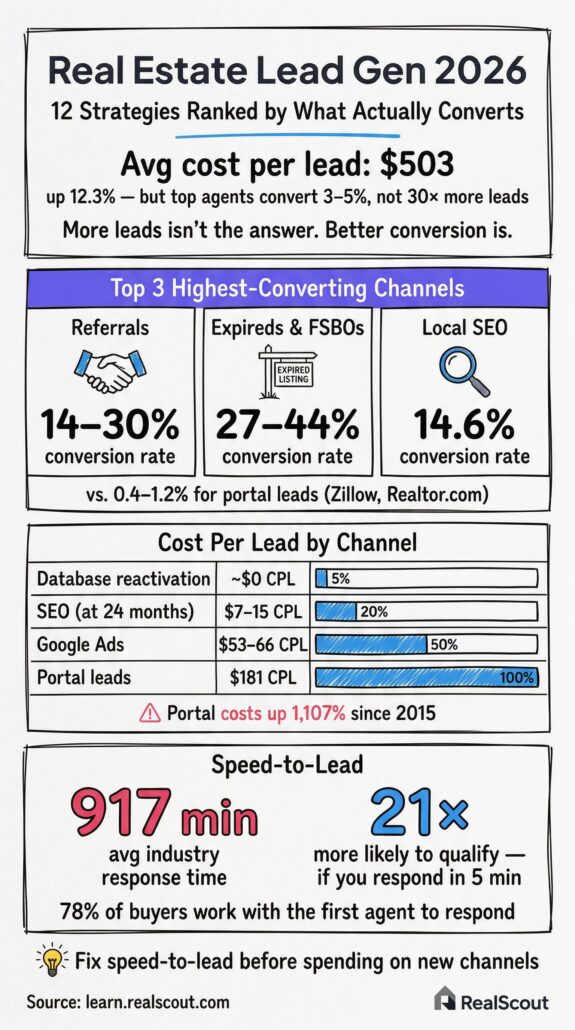
The average cost per lead in real estate hit $503 in 2026, up 12.3% from the prior year, according to a NAR survey of 5,400 professionals. Most agents respond by chasing more real estate lead generation volume. That’s the wrong lever.
The national average conversion rate is 0.4% to 1.2%. Top-performing agents hit 3% to 5%. The difference isn’t the lead source. It’s the system behind it. An agent converting 3% of 500 leads closes more deals than an agent converting 0.5% of 2,000 at three times the cost. Lead generation is one of seven core systems in a complete real estate agent business framework — this guide covers it specifically.
The 12 strategies below are ordered by conversion rate and ROI, starting with the highest-leverage plays. Each includes specific cost benchmarks, named case studies, and a clear recommendation so you can build the right mix for your market and budget.
Key Takeaways
- Prioritize which lead channels convert the highest and what they cost per closing, not just per lead.
- A framework for choosing 2 to 3 strategies that match your budget and business stage.
- Database reactivation delivers 10 to 20x ROI compared to buying new leads.
- Speed-to-lead makes agents 21x more likely to qualify a lead.
How do real estate lead sources compare?
Real estate lead sources vary widely in both conversion rate and cost per lead. The table below compares the main channels covered in this guide. Database reactivation isn’t shown as a fixed percentage because it converts at 3 to 4 times the rate of new leads, but it carries the lowest cost and highest ROI of any channel here.
Lead source | Conversion rate | Cost |
|---|---|---|
Expired listings | 43% to 44% | $300 to $500 per closing (REDX) |
FSBOs | 27% to 38% | $300 to $500 per closing (REDX) |
Referrals and repeat business | 14% to 30% | Low; incentive-based |
Local SEO and content marketing | 14.6% | $7 to $15 per lead (at 24 months) |
Google Ads | 5% to 10% | $53 to $66 per lead |
Facebook Ads | 1% to 3% | $26.43 per lead |
Social media | 1% to 3% | Low to moderate |
Portal leads (Zillow, Realtor.com) | 0.4% to 1.2% | $181 per lead average |
1. Referrals and Repeat Business
Referral leads convert at 14% to 30%. Portal leads convert at 0.4% to 1.2%. That 10 to 25x gap is the single most important number in real estate lead generation, and most agents treat referrals as passive luck rather than a system.
According to NAR, 43% of buyers find their agent through a referral from a friend, neighbor, or family member. For sellers, that number climbs to 65%. Eighty-seven percent of clients say they’d recommend their agent, yet fewer than half ever hear a direct ask after closing.
The referral system has three components: a structured closing-day ask (“I’m growing my business through referrals from clients like you. If you know anyone thinking about buying or selling, I’d be grateful for the introduction”), a quarterly check-in calendar for past clients, and a low-cost incentive (a gift card, a charitable donation in their name, or a local experience voucher).
The math favors depth over volume. Agents who optimize conversion rather than lead count consistently outperform higher-spending competitors at a fraction of the cost.
If you close 10 or more deals a year and don’t have a post-closing referral sequence in place, start there before spending another dollar on paid leads.
2. Database Reactivation
Ninety-three percent of past clients list their next home with a different agent. That statistic, from a Tom Ferry and Revaluate study of 500,000 contacts, accounts for an estimated $2.57 billion in lost listing volume annually.
The leads aren’t gone. They’re dormant. Sixty-two percent of contacts in a so-called “dead” database hold 40% or more home equity, according to research by Michael Torres of Elevation Real Estate in Denver. These aren’t cold prospects. They’re future sellers who stopped hearing from their last agent.
The economics of reactivation are hard to argue with. Reactivating a dormant contact costs 5 to 10 times less than acquiring a new lead and converts at 3 to 4 times higher rates. SMS reactivation alone generates a 15% to 30% response rate within 48 hours, faster than any paid channel.
A structured reactivation campaign works in 7 to 12 touches over 30 to 60 days: a conversational text on Day 1, a value-add market stat on Day 7, a personalized video on Day 14, a phone call on Day 21, and a handwritten note on Day 30. Agents who run this sequence reactivate 5% to 15% of a dead database. That’s not a marginal improvement. That’s a different business.
Clients who transacted 3 or more years ago are entering their natural re-purchase window. Forward-thinking agents contact these clients before they start searching on their own.
Database reactivation is the highest-ROI lead gen strategy available to any agent with 100 or more past contacts. It’s free, it converts, and it compounds.
Want the full framework? Download Dead Database to Deal Machine, a free guide with the complete 30-day reactivation playbook, scripts, and case studies from agents who turned a neglected database into their top listing source.
3. Expired Listings and FSBOs
Expired listings convert to listing appointments at 43% to 44%. FSBOs convert at 27% to 38%. Both dramatically outperform portal leads at 0.4% to 1.2%, according to REDX 2026 data. These sellers have already demonstrated intent.
Expired listings represent sellers who tried and failed with a previous agent. They want a solution, not more promises. FSBOs are sellers discovering firsthand how difficult it is to sell without professional representation.
Deric Lipski, a REDX top producer, listed 28 homes in a single month by exclusively prospecting expired listings. His process: pull fresh expireds every morning, call within 24 hours, focus on why the home didn’t sell rather than why he’d be better, and present a specific different marketing approach.
One underused tactic: old expireds from 3 to 4 years ago. Most agents compete for fresh expireds, leaving older inventory largely uncalled. Cost-per-closing with a prospecting tool like REDX runs $300 to $500, the lowest among all lead vendors.
Best for: Agents comfortable with outbound calling who want seller listings quickly. Skip if: You’re unwilling to make 20 or more prospecting calls per day or aren’t prepared for the rejection that comes with cold outbound.
4. Google Business Profile and Local SEO
SEO leads convert at 14.6%. That’s higher than Google Ads at 5% to 10%, social media at 1% to 3%, and portal leads at 0.4% to 1.2%. The cost drops to $7 to $15 per lead at the 24-month mark. No other channel offers that combination of high conversion and declining cost.
Google Business Profile optimization is the fastest SEO win available. Complete every field, upload photos of listings and neighborhoods, post weekly market updates, and collect reviews systematically after every closing. That’s what puts you in the Google Map Pack for “[city] real estate agent” searches.
Content marketing follows the same cost trajectory: $80 to $100 per lead in months 0 to 3, $30 to $50 in months 7 to 12, and $7 to $15 at the 24-month mark, per Ampifire data. That compounding cost reduction isn’t matched by any paid channel.
Video accelerates both. Properties listed with video receive 403% more inquiries than those without, and 73% of homeowners say they’re more likely to list with an agent who uses video marketing.
Local SEO matures to $7 to $15 CPL. Google Ads run $53 to $66. Zillow runs $181. The trade-off is 12 to 24 months of upfront effort for dramatically lower cost over time.
5. Content Marketing and SEO
Portal lead costs have risen 1,107% since 2015. Content marketing CPL has dropped to $7 to $15 over the same period. One channel is compounding against you; the other is compounding for you.
Every piece of content you publish is a permanent, indexed asset that generates leads indefinitely. A blog post on “moving to [city]” written in 2024 still ranks in 2026. A Zillow ad spend from 2024 generated exactly zero leads after you stopped paying.
Hannah Dubyne generates double-digit monthly leads from YouTube after three years of consistent, keyword-optimized posting. Her approach: research what buyers and sellers are already searching for, create evergreen answers to those questions, and include a lead-magnet call to action in every video description.
The content architecture that compounds fastest combines a local YouTube channel (neighborhood tours, market updates, buyer/seller FAQs), a blog targeting “homes for sale in [city],” “moving to [city],” and first-time buyer guides, and a lead magnet gated behind an email form. Every element feeds the others.
Best for: Agents committed to a 12-month or longer content strategy who want to reduce CPL over time. Skip if: You need leads in the next 30 days or can’t consistently produce one to two pieces of content per week.
6. Email Drip Campaigns and Marketing Automation
Email marketing returns $42 for every $1 spent. Drip campaigns generate 4 to 10 times more responses than single emails. The average real estate email open rate is 21.3%. These numbers make email the highest-ROI marketing channel available to agents who use it systematically.
Marketing automation turns that ROI into scale. Gartner data shows automation delivers a 451% increase in qualified leads, and nurtured leads make 47% larger purchases than those who receive sporadic outreach.
The drip architecture that converts segment contacts by purchase timeline: buyers within 0 to 3 months receive weekly listing alerts; the 3 to 6 month segment gets bi-weekly market stats; the 6 to 12 month segment gets monthly reports; and the 12-month-plus segment receives automated quarterly check-ins. Every segment gets relevant content on autopilot.
Greg Harrelson’s research frames the stakes: true market conversion across all agents is 10% over 12 months. Individual agent conversion averages 1% to 3%. That gap represents leads converting with competitors. The agent who follows up longest wins, and automation is the only way to do that at scale.
Set up a 12-month automated drip sequence this week. Every lead entering your CRM should receive value-driven touches on autopilot. This is non-negotiable for any agent generating more than 20 leads per month.
7. Social Media Lead Generation
Fifty-four percent of agents cite social media as their highest-quality lead source, per The Close and NAR. Facebook is used by 92% of agents, Instagram by 68%, TikTok by 12%, and growing. The platform question matters less than the approach: most agents broadcast when the platform rewards the relationship.
Stevie Hahn generates 75% of her real estate business from social media. Her strategy isn’t complicated: be authentic, post consistently, follow everyone you meet in person, and engage with every comment. Authenticity outperforms production quality on every platform.
For seller-focused Facebook ads, a Keller Williams agent generated 50 or more motivated seller leads at under $4 per lead by testing three variants of a home value lead magnet. She received two listing appointments in month 1.
Sarah Henderson, a Chicago agent, spent 30 minutes per day on Reddit for 18 months answering real estate questions without pitching her services. Result: 43 closed transactions and more than $14 million in volume from community members who sought her out directly.
Social media converts when you treat it as a relationship channel rather than an ad platform. Pick one platform, post daily, engage with every comment, and add a lead magnet link to your bio.
8. Open Houses as a Lead System
Every open house attendee falls into one of three categories: an active buyer, a future seller assessing what their own home might be worth, or a neighbor gathering market intelligence. Most agents only capture the first group.
A systematic open house lead capture changes that. Replace paper sign-ins with a digital QR code registration that captures name, email, and phone number reliably. Prepare a neighborhood-specific market report for non-buyer visitors, which invites the conversation: “I put this together for the neighbors who come through. What would your home sell for in this market?” That question surfaces seller leads most agents walk past.
Alex Piech built a practice of 300 transactions per year largely through circle prospecting after open houses, calling the surrounding neighborhood while the property was active. Neighbors who attended are 10 times warmer than a cold-called homeowner who’s never seen your name.
The follow-up protocol: text every registered visitor within 2 hours, email the market report within 24 hours, call within 48 hours.
Best for: Agents with active listings in desirable neighborhoods who want volume leads at zero ad cost. Skip if: You’re holding open houses without a digital sign-in system. You’re leaving leads at the door every time.
9. Geographic Farming
Tom Ferry coaches consistently identify inconsistency, not poor area selection, as the primary reason geographic farming fails. Most agents quit after 3 to 4 months, well before the 6 to 12-month horizon when the strategy starts generating traction.
Farm selection criteria: 500 to 2,000 homes, 5% to 8% annual turnover rate, no competing agent currently holding more than 25% market share, and within a 10-minute drive.
The 12-Month Farm Playbook runs in three phases. Months 1 to 3: direct mail introduction and door-knocking 10 doors per week. Months 4 to 6: monthly market reports mailed to every home, plus neighborhood-specific social content. Months 7 to 12: quarterly community events, just-listed and just-sold cards after every transaction in the farm, and follow-up with every open house visitor from farm listings.
The target is 10% of the listing inventory in the farm within 12 to 18 months of consistent execution. One agent captured 40% market share and more than 20 listings per year from a 1,500-home farm. The fix isn’t complicated. It’s consistent.
Best for: Agents who want a predictable, compounding listing pipeline and can commit to 12 or more months. Skip if: You need leads in 90 days or aren’t willing to invest in direct mail, door-knocking, and community events.
10. Paid Ads: Google and Facebook
Google Search ads produce leads at $53 to $66 per lead nationally. Facebook ads average $26.43 per lead in 2026, up 20.2% from 2025. The question isn’t which is cheaper. It’s which converts at a rate that justifies the spend, given your follow-up infrastructure.
Google Ads convert at 5% to 10%, capturing active search intent. Facebook Ads convert at 1% to 3%, generating passive awareness that requires longer nurture. Google works faster; Facebook requires a CRM and 6 to 18 months of follow-up.
Chris Phares, a single agent using Ylopo, achieved a 461% ROI: $2,500 per month in ad spend generated $112,310 in GCI over 8 months. That result required a functioning drip system, not just ad spending.
Buyer leads from paid ads average $9 to $20 CPL. Seller leads run $26 to $30 or more. Retargeting website visitors who have already viewed listings significantly lowers CPL compared to cold audiences on both platforms.
Start with Google Ads at $500 to $1,000 per month, targeting high-intent buyer keywords. Add Facebook only after your CRM and follow-up sequence are operational.
11. Third-Party Lead Portals: Zillow, Realtor.com, and Alternatives
Portal lead costs have risen by 1,107% since 2015, according to REDX 2026 data. Average portal CPL is $181, with nurture cycles that commonly exceed 24 months. Conversion rates remain at 0.4% to 1.2%, unchanged despite the cost increase.
Zillow Premier Agent costs $300 to $7,700 per month, depending on the market, with a minimum 6-month contract. In competitive markets like Manhattan, meaningful impression share starts at $7,700 per month. Leads aren’t exclusive: the same inquiry can reach multiple agents. Agent reviews on G2 average 2.2 out of 5.0. “Zillow leads are worthless” (Russell Brazil). “80% of the leads are garbage” (Ryan Bakerian, 3-year user).
Realtor.com ReadyConnect charges no upfront cost but takes a 30% to 35% referral fee at closing. On a $300,000 sale at 3% commission, that’s roughly $2,700 to ReadyConnect on a $9,000 gross commission. Many routed leads already have representation when connected.
The exception: new agents in affordable markets who need transaction experience can use portals as a short-term bridge while building owned lead systems.
Use portals as a bridge, not a foundation. Build referral systems, content, and a database in parallel.
12. Speed-to-Lead Response System
The average real estate agent takes 917 minutes, more than 15 hours, to respond to a new lead. Meanwhile, 78% of buyers work with the first agent who responds, and agents who respond within 5 minutes are 21 times more likely to qualify that lead than agents who wait 30 minutes.
Speed-to-lead isn’t a lead source. It’s the multiplier that determines whether every other strategy on this list actually converts.
Sixty-two percent of real estate inquiries arrive outside business hours. Eighty-nine percent of consumers prefer text over phone calls as an initial contact. Lead response rates decline by a factor of 10 after the first hour, and each unresponsive lead represents $7,500 or more in potential lost commission.
The 5-Minute Protocol: an automated text response fires within 60 seconds of receiving the inquiry, confirming receipt and asking one qualifying question. The agent follows up by phone within 5 minutes during business hours. For after-hours leads, a 5-day multi-touch sequence is triggered: 3 call attempts on Day 1, email on Day 2, text on Day 3, and a call plus voicemail on Day 5.
Michael Urbanski consistently closes 8% to 10% of his online leads by responding within minutes and maintaining contact for 5 days on every new inquiry. AI-assisted response systems report 40% or more improvement in lead capture rates, according to Inman and Real Trends 2025 data.
Audit your average lead response time this week. If it exceeds 15 minutes, fix that before investing in any new lead source.
FAQ
How do you generate real estate leads?
Generate real estate leads by prioritizing the highest-converting channels first: referrals, database reactivation, and expired or FSBO listings all convert far above the 0.4% to 1.2% typical of portal leads. Add local SEO, email automation, and social media to compound results over time, then layer in paid ads once your CRM and follow-up sequence are running. Respond to every new lead within 5 minutes.
How many leads does a real estate agent need to close one deal per month?
At a 1% conversion rate, you need 100 leads per month to close one deal. At 3% (top 10% of agents), you need 33. At 14% (referrals), you need 7. The primary lever isn’t volume. Doubling your conversion rate from 1% to 2% has the same economic impact as doubling your lead budget with no improvement in conversion.
What is the cheapest real estate lead source?
Database reactivation costs near zero and converts at 3 to 4 times the rate of purchased leads. Among paid sources, REDX expired listing prospecting runs $300 to $500 cost per closing. Zillow and portal leads run $900 to $4,000 or more per closing depending on market, making them the most expensive source when measured by outcome rather than input cost.
Should I focus on buyer leads or seller leads?
A seller transaction takes approximately 7 hours of agent time. A buyer transaction takes approximately 29 hours, making sellers 4.5 times more time-efficient per deal. However, 66% of buyer leads currently own a home, meaning a buyer lead today is also a latent seller lead. Most high-volume producers focus on listing inventory but maintain a buyer program to seed future seller pipeline.
How fast should I respond to a new lead?
Under 5 minutes. Agents who respond within 5 minutes are 21 times more likely to qualify the lead than agents who wait 30 minutes. The industry average is 917 minutes. This isn’t a marginal gap. Fix response time before investing in more lead volume.