


Tens of thousands of real estate agents quit every year. The pattern is consistent across markets, experience levels, and brokerages. The common explanation is that real estate is hard.
The real explanation is that most agents never build a business. They just start doing real estate.
Tom Ferry puts it bluntly: failure stems from treating real estate as a hobby, not a business. The root causes (running out of money, no business plan, magic pill syndrome, call reluctance) are all symptoms of missing systems, not missing talent. This real estate agent success guide is built on that distinction.
The practitioner’s mindset reacts to whatever happens next. Business-owner mindset builds repeatable systems that produce predictable outcomes.
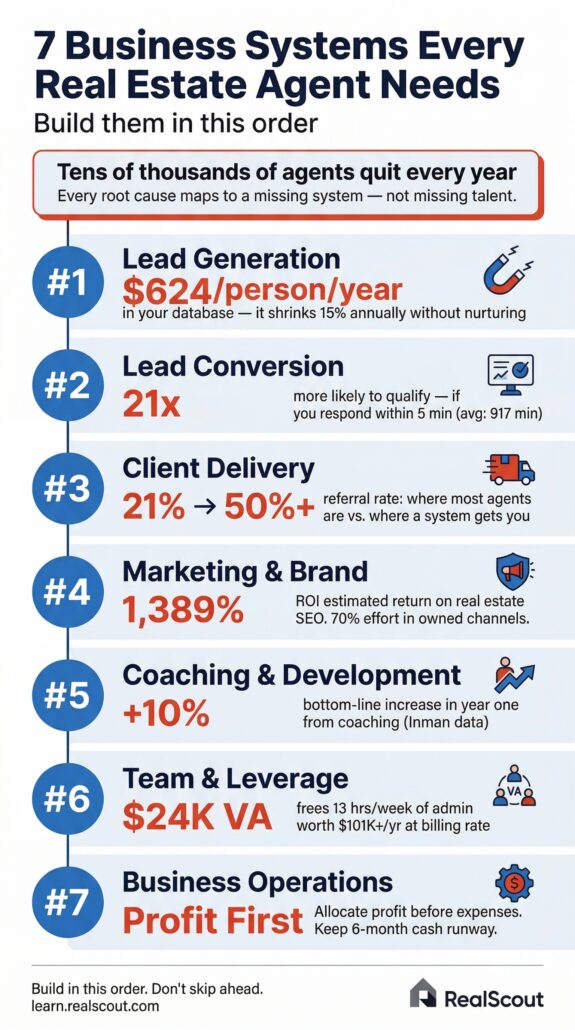
The 7 Business Systems Framework covers the same infrastructure any $1M+ company runs on: lead generation, lead conversion, client delivery, marketing, professional development, team support, and financial operations. Real estate just pretends they don’t apply. Build them in the order presented rather than chasing the system that sounds most exciting.
Key Takeaways
- Build a lead generation system that produces a predictable pipeline without cold-calling dependency
- Convert leads at 3-5% instead of the industry-average 0.5-1.2%
- Create a personal brand that generates inbound leads through SEO, video, and social proof
- Know exactly when to hire, what to delegate, and the ROI math behind every team decision
- Run your practice on a Profit First financial model instead of commission-to-commission survival
- Evaluate real estate coaching programs by ROI data, not testimonials
Here are the seven systems, in the order you should build them.
1. Lead Generation System: Build a Predictable Pipeline
Every person in your database is worth roughly $624 per year in commissions. A 100-person sphere equals $62,400 in annual income potential. But your database shrinks 15% annually without active database nurturing. Doing nothing is actively expensive.
The MREA Lead Formula
Start with math. Gary Keller’s Millionaire Real Estate Agent model reverse-engineers your income goal into daily activity targets. The formula: Goal GCI divided by Average Commission equals Deals Needed. Deals Needed divided by 6.37% (the MREA contact-to-close benchmark) equals Minimum Contacts Needed.
Worked example: $200K GCI target divided by $8K average commission equals 25 deals. 25 divided by 6.37% equals 393 contacts needed annually, or about 8 per week. Once you have the number, you stop guessing and start executing.
Channel Economics: Where the Math Actually Works
Not all lead sources produce the same return:
- Referrals: 92.8% effectiveness rate, lowest cost, highest close rate.
- SOI/database: For every 12 people marketed to 33 times per year, expect 2 sales (1 repeat, 1 referral).
- Geographic farming: Target areas with 5-8% annual turnover, 200-1,000 homes, and below 10% agent saturation. Agents who invest in hyperlocal market expertise report strong ROI after 12-18 months of consistent effort.
- Google PPC: $70.11 average cost-per-lead, $5.26 average CPC. Fast volume, zero compounding.
- Cold calling: 57.1% effectiveness rate, high burnout. Still generates half of all real estate leads when combined with direct mail.
- AI-assisted prospecting: 68% of Realtors have used AI tools for real estate per the NAR 2025 Technology Survey, but only 17% report significant business impact. That gap represents an implementation problem, not an adoption problem.
The Tom Ferry Morning Block
Tom Ferry’s Perfect Day framework protects the first 90 minutes of your workday for prospecting: no email, no admin, no showings. “Your income grows in the hours you protect, not the hours you react.” The solution to call reluctance is a scheduled system, not willpower.
Karin Carr proves lead generation without cold calling works. She built her YouTube channel from zero to 17,000+ subscribers, and 70-75% of her business now comes from video. One video generated $100K in GCI. It required weekly publishing for over a year before results compounded.
If you’re under 20 transactions, start with SOI plus one content channel. If you’re at 20-40, add geographic farming or paid digital. The formula stays the same. Only the inputs scale.
2. Lead Conversion System: Turn Responses Into Signed Agreements
The average real estate agent takes 917 minutes (over 15 hours) to respond to a new lead. Agents who respond within 5 minutes are 21x more likely to qualify that lead. 78% of buyers work with the first agent who responds. That gap represents the entire difference between a struggling agent and a thriving one.
The 5-Minute Rule and CRM Automation
Speed-to-lead is the single highest-ROI fix in most agents’ businesses. Modern CRM automation turns this into a system:
- Instant auto-response (text plus email) within 60 seconds of any inquiry
- AI-assisted lead scoring to prioritize hot prospects
- Automated drip sequences for longer-term nurture
- 62% of real estate inquiries arrive outside business hours, so automation covers gaps you physically cannot
Follow Up Boss ($69/user/month) is strongest for teams with 250+ integrations and accountability dashboards. kvCORE ($299+/month) works best as an all-in-one platform for brokerages. LionDesk fits solo agents on a budget with its built-in AI assistant and video messaging. Before committing to any platform, use a real estate CRM buying framework that accounts for team size, automation depth, and data portability.
Robert Slack’s team improved their connection rate from 34% to 65% by implementing a 45-day CRM text automation campaign. That’s not a marginal improvement. That’s a different business.
The Follow-Up Cadence That Closes
80% of sales require five or more follow-up contacts after the initial inquiry. Most agents quit after one or two attempts. The Keller Williams 8×8 and 33-touch system removes the decision of “should I follow up again?” from your daily workflow. The cadence decides, not your feelings.
Kevin Ward’s Book of YES contains 27 scripts covering every agent conversation, from expired listings to FSBO objections. Top agents train these scripts 1-2 hours daily. Scripts are preparation, not manipulation.
Conversion Benchmarks to Track
Three KPIs tell you whether conversion is your bottleneck: lead-to-appointment rate, appointment-to-signed rate, and overall lead-to-close rate. The industry average sits at 0.5-1.2%. Your target is 3-5%. If you’re below 1%, the problem is conversion, not lead volume.
Best for agents spending $500+ per month on lead gen with close rates below 2%. Skip if your pipeline is empty. Fix System 1 first.
3. Client Delivery System: Create an Experience Worth Referring
NAR reports that 21% of agent business comes from past client referrals. That number should be 50% or higher. The gap between 21% and 50% is a delivery system: a repeatable client experience designed to generate referrals, not just close transactions.
Map Every Touchpoint
Client delivery is a process map, not improvisation. A complete system includes:
- Pre-listing or pre-showing preparation package
- Weekly update cadence (automated plus personal)
- Transaction milestone communications (offer accepted, inspection complete, clear to close, closing day)
- Post-close: 30-day check-in, 90-day check-in, annual home anniversary
- Referral ask is built into the timeline at specific behavioral signals, not left to chance
Every touchpoint is designed in advance. Consistency creates trust. Trust creates referrals.
The Post-Close Referral Engine
Most agents disappear after closing. The 33-touch system applies to past clients too. They need to hear from you 33 times per year to stay in your active database. Mix value-add content, market updates, personal touches, and direct referral asks.
Remember the SOI economics: each person equals $624 per year. Losing a past client from your database costs real money. Your database shrinks 15% annually without nurturing. This is the leak most agents ignore, and database re-engagement is where the fix starts.
Systematize With Technology, Personalize With Intention
Use CRM automation for the cadence. Use personal effort for the moments that matter: handwritten notes at closing, anniversary gifts, and personal check-ins during life events. The system handles the 80% that’s repeatable. You handle the 20% that’s human.
If your repeat and referral rate is below 30%, you don’t have a delivery problem. You have a follow-up problem. Build the post-close sequence first. It’s the highest-ROI system change most agents can make in a single afternoon.
4. Marketing and Brand System: Own Your Audience Instead of Renting It
71% of buyers choose agents with a strong social media presence. 46% of Realtors say social media is their top source of quality leads. The opportunity is real, but only if you own the asset. Building your brand on your brokerage’s infrastructure means starting over the day you leave.
Local SEO: The Compounding Channel
The tactics that produce the most durable results in any real estate agent success guide involve SEO:
- 53% of all website traffic comes from organic search
- Real estate SEO produces an estimated 1,389% ROI
- 97% of buyers start their home search on Google
- 43% of SEO traffic converts to a lead within 30 days
- Google Business Profile optimization alone moves the needle: businesses with 100+ photos receive 520% more calls and 1,065% more website clicks
Specific tactics: GBP optimization with 50+ reviews and 100+ photos, neighborhood-specific landing pages, monthly market report content, and IDX integration on your personal website. SEO pays you while you sleep. Paid ads stop the moment you stop spending.
Video and Social Proof at Scale
Karin Carr’s results (17,000+ YouTube subscribers, 70%+ of business from video, one video worth $100K GCI) prove what’s possible. Pick one content platform and become the local authority on it.
Ryan Serhant’s framework: define your “AND,” the thing that makes you memorable beyond real estate. His personal brand strategy is built on identity-driven content rather than listing-driven content — own what makes you distinct, then let that pull clients in.
82% of consumers now use AI tools for housing information. Your content competes with AI-generated answers, not just other agents.
The Owned vs. Rented Framework
Categorize every marketing channel you use:
- Owned: Your website, email list, YouTube channel, blog. Compounds over time, fully portable, you control it.
- Rented: Zillow leads, brokerage website, Facebook page organic reach. Can disappear or change terms overnight.
- Earned: Referrals, press mentions, reviews. Highest trust, lowest direct control.
The system: allocate 70% of your effort to owned channels, 20% to earned, 10% to rented. Most agents have that ratio inverted.
If you don’t have a Google Business Profile with 50+ reviews and 100+ photos, start there. It’s free with the highest immediate ROI. If you do, pick one content channel and commit to weekly publishing for 12 months before judging results.
5. Coaching and Development System: Train Like the Business Depends on It
Coaching skepticism is the most expensive mindset in real estate. An Inman study found coaching produces a 10% bottom-line increase in year one. One data-driven program documented a 39% GCI increase, with participants averaging 110 homes per year and $485K GCI.
The question isn’t whether coaching works. It’s the type that works for your stage.
The ROI Math on Coaching
Standard programs cost $350-$700 per month. Elite programs run $12K-$50K per year. If coaching costs $6K annually and your GCI is $60K, a 10% increase equals $6K: break-even in year one, compounding from there. One extra closed deal per month at $8K commission equals $96K annual revenue against a $12-18K investment.
Kevin Ward’s framework: top agents train 1-2 hours daily, 30 minutes of role-play plus 30 minutes of solo practice. Training is the real work.
On-Demand vs. Accountability Models (2026)
Match the right model to your situation:
- Accountability coaching ($350-$700/month): Weekly calls, business planning, goal tracking. Best for agents who know what to do but don’t do it consistently.
- Skill-based training ($97-$300/month): Script practice, roleplay, technique development. Best for agents who don’t know what to say yet.
- Mastermind/peer groups ($200-$500/month): Peer accountability plus idea sharing. Best for experienced agents seeking edge cases and network.
- On-demand/AI-assisted coaching: Emerging in 2026 with AI roleplay partners, on-demand script practice, and video analysis. Lower cost, higher frequency, no scheduling friction.
When to Start and What to Expect
NAR income progression provides the backdrop: Year 1-2 median is 3 transactions, Year 3-5 is 8, Year 6-15 is 11. Coaching accelerates these jumps, but expecting results in month one is magic pill syndrome again. Give any program two full quarters before evaluating ROI.
Under $50K GCI: invest in a skill-based program at $97-$300 per month. Over $50K GCI: accountability coaching at $350-$700 per month will produce measurable ROI within two quarters. Over $150K GCI: elite coaching or mastermind groups where the network itself generates deal flow.
6. Team and Leverage System: Scale Without Drowning in Overhead
Agents spend an average of 13 hours per week on administrative tasks. At a $150/hour billing rate, that’s $1,950 per week in lost revenue, or $101,400 per year. A full-time virtual assistant costs $24K annually. That’s a 400% net ROI on your first hire, and you don’t need a traditional team to capture it.
The Transaction Threshold Framework
Specific benchmarks tell you when to add support:
- 40 transactions per year: The cusp of solo capacity. This is the ceiling most agents hit before burnout forces a decision.
- 10+ transactions per month: A VA pays for itself immediately from freed capacity alone.
- Under 40 transactions: Focus on Gary Keller’s Three Ls in order: Leads, Listings, Leverage. Don’t hire for support until Systems 1-3 are producing consistent volume.
Modern Support Stack (Not Just Headcount)
Forward-thinking agents build support in tiers, not leaps:
- Tier 1, Tech: CRM automation, transaction management software, AI-assisted communications. Cost: $200-$500 per month. Replaces 5-8 hours per week of manual work.
- Tier 2, VA: Remote admin, transaction coordinator, social media manager. Cost: $1,500-$3,000 per month. Replaces 10-15 hours per week. Reduces overhead 60-70% versus a full-time in-office employee.
- Tier 3, Agent: Buyer’s agents, showing assistants, listing specialists. Cost: commission split. Only makes sense at 40+ transactions when you have more leads than you can personally serve.
The Delegation Decision Matrix
Categorize every task in your week: (a) dollar-productive and requires you, (b) dollar-productive and doesn’t require you, (c) not dollar-productive. Delegate categories (b) and (c). Most agents try to delegate (a) first, and that’s how you lose clients.
If you’re doing 20-40 transactions and feeling maxed out, hire a VA before a buyer’s agent. The math is unambiguous: $24K investment, $120K+ in freed revenue capacity. If you’re under 20 transactions, invest in tech (Tier 1) and protect your prospecting hours instead.
7. Business Operations System: Run Your Numbers Like a Real Business
Running out of money is the top reason agents leave real estate. It happens to agents earning $100K+ GCI just as often as those earning $30K. The problem isn’t income. It’s the absence of a financial operating system.
Most agents can tell you their GCI but not their profit margin, their cost per deal, or their effective hourly rate.
Profit First for Real Estate
The traditional accounting formula (Sales minus Expenses equals Profit) keeps agents broke because profit is always last in line. Mike Michalowicz’s Profit First framework flips it: Sales minus Profit equals Expenses. From each commission check, allocate fixed percentages into separate bank accounts for profit, owner’s pay, taxes, and operating expenses.
The MREA budget model provides benchmarks: Cost of Sales at 29.2%, Operating Expenses at 29.2%, and a Profit target of 41.6%. Profit isn’t what’s left over. It’s what you allocate first.
The Five Numbers Dashboard
Every agent should track these five metrics weekly:
- Cost per lead (broken down by source)
- Cost per transaction (total expenses divided by closed deals)
- Profit per transaction (net income after all costs)
- Effective hourly rate (GCI divided by actual hours worked)
- Cash runway (months of expenses currently in reserve)
The 6-month expense reserve recommendation isn’t conservative. It’s survival math.
Tax Strategy as Competitive Advantage
Most agents overpay taxes because they don’t structure correctly. S-corp election, quarterly estimated payments, home office deduction, vehicle deduction, and continuing education deduction all reduce your tax burden legally.
The fix isn’t complicated. It’s consistent. Find a CPA who understands 1099 real estate income.
NAR Income Benchmarks for Context
NAR’s 2025 Member Profile puts median GCI at $58,100 with median expenses of $8,010. Year 1-2 agents: median 3 transactions, $500K volume. Year 3-5: 8 transactions, $1.6M. Year 6-15: 11 transactions, $3.2M.
The agents at the top of each bracket have all seven systems running.
Open separate bank accounts this week. One for profit, one for taxes, one for operating expenses. Set up automatic transfers from each commission deposit. This single change will do more for your financial stability than any lead generation tactic.
Frequently Asked Questions About Real Estate Agent Success
How long does it take to become a successful real estate agent?
NAR data shows Year 1-2 agents close a median of 3 transactions for $500K in volume. By Years 3-5, that jumps to 8 transactions and $1.6M. Years 6-15 reach 11 transactions and $3.2M.
Agents with all seven business systems from this real estate agent success guide compress these timelines significantly. Plan for 12-24 months to reach sustainable income with systems, or 3-5 years without them. Save six months of living expenses before you start.
How much do first-year real estate agents make?
NAR’s overall median GCI is $58,100, but first-year agents fall well below that. Year 1-2 median: 3 transactions at roughly $8K commission equals about $24K. The variance is enormous: some first-year agents close zero transactions, others close 15+. The difference is almost always systems, not talent or market conditions.
What is the best CRM for real estate agents?
Follow Up Boss ($69/user/month) is best for teams prioritizing lead conversion, speed-to-lead accountability, and integrations with 250+ platforms. kvCORE ($299+/month) is the strongest all-in-one option for brokerages wanting built-in lead gen and IDX. LionDesk works well for solo agents on a budget with its AI assistant and video messaging.
The best CRM is the one you actually use consistently. Robert Slack’s team saw a 34% to 65% connection rate improvement. The tool mattered less than the automation built inside it.
Is real estate coaching worth the money?
Yes, with caveats. Inman data shows a 10% bottom-line increase in year one. One program documented a 39% GCI increase.
ROI depends on matching the right coaching type to your stage. Under $50K GCI: skill-based training at $97-$300 per month. Over $50K: accountability coaching at $350-$700 per month. Over $150K: elite programs or masterminds at $12K-$50K per year.
The coaching skepticism (“why pay when I’m barely making money?”) is precisely backwards.
When should a real estate agent hire their first assistant?
40 transactions per year marks the cusp of solo capacity. But a virtual assistant at $24K per year makes financial sense much earlier. At 20+ transactions, the 13 hours per week of admin you free up is worth $101K+ annually at your billing rate.
Start with a VA before hiring a buyer’s agent. The ROI is immediate.
How do real estate agents get leads without cold calling?
Multiple proven channels produce results without a phone: SOI database marketing (33-touch system), local SEO (53% of web traffic, estimated 1,389% ROI), video content (Karin Carr generates 70%+ of business from YouTube), geographic farming (10:1 ROI after 12-18 months of commitment), and Google PPC ($70 average cost-per-lead). Cold calling works (57.1% effectiveness) but it’s not required if you build a multi-channel lead generation system.
What percentage of real estate agents fail?
The attrition rate is well-documented: tens of thousands of agents exit every year, and the pattern holds across markets, experience levels, and brokerages. The root causes are not about talent: running out of money (no financial system), no business plan (no operations system), treating real estate as a hobby (no lead gen system), magic pill syndrome (no development system), and call reluctance (no conversion system).
Every root cause maps to a missing business system. The pattern holds across markets, experience levels, and brokerages.
The Bottom Line
The agents who make it past year five aren’t more talented. They’re more systematic. Build these seven systems in the order presented, measure what matters, and treat your real estate practice like the business it is.