

Inside Compass’s walled-garden strategy and the open ecosystem that could become its most powerful counterweight.
By: Andrew Flachner
In 2019, I stood onstage at the T3 Leadership Summit and warned brokerage leaders about a dynamic I believed could fundamentally reshape residential real estate.
My argument was that once a brokerage accumulated enough market share, it could unlock capabilities that even large, established competitors would struggle to reproduce on their own. The first of those capabilities came from the listings themselves. With enough inventory, a brokerage could put a meaningful share of the market behind a velvet rope. That inventory could attract buyers. Buyer activity could generate valuable demand data. That demand could help win more sellers and recruit more agents, producing still more listings.
At some point, the system stops growing linearly and starts compounding. I called that moment the tipping point, and argued that market share itself could become a competitive superpower.
After that presentation, I took the same argument directly to brokerage leaders and portal executives in meetings across the country. And for me, it wasn’t abstract. I was living in San Francisco at the time and watching it begin to happen around me.
One example I shared was almost comically mundane: I was trying to find my neighbor’s listing. It wasn’t on the MLS. It wasn’t on Zillow or Realtor.com. After some digging, I found it in Compass’s coming soon inventory. When I pulled up all of Compass’s coming soon listings in San Francisco, the volume was staggering.
I remember thinking about what that meant for a buyer. If more and more desirable inventory sat behind one brokerage’s velvet rope, eventually you might not be able to simply choose the agent you thought was best for you. You’d feel pressure to choose the brokerage that had the goods.
In fact, I said exactly that in 2019: buyers would feel like they had to work with the brokerage that had the exclusive listings, sellers would then want access to those buyers, agents would feel pressure to join the brokerage, and the cycle would repeat.
That was 2019.
Today, Compass has dramatically more scale; private and pre-market inventory sits at the center of its three-phase marketing strategy; and the Anywhere brands now operating with Compass under the Compass International Holdings umbrella give the combined company vastly more supply, agents, and consumer relationships with which to run the play.
The question is no longer whether this strategy could become powerful.
It already has.
The question is what everyone else will do about it.
Why should you trust me?
I should acknowledge an obvious conflict of interest before going further.
I co-founded RealScout, and some of the strategy I’m going to recommend involves technology we provide. I have a financial interest in brokerages choosing RealScout.
I still feel strongly about writing this because the strategy I’m recommending today continues the one I laid out in 2019.
Back then, I described two competitive “superpowers” that become available when a brokerage reaches sufficient scale. The first was the ability to make the market: bring enough supply and demand together that participants increasingly need access to your network. The second was the ability to differentiate through data: use the activity generated inside that network to build products and intelligence that others cannot match.
And I offered a specific counterstrategy for companies that couldn’t reach that scale on their own: pool your network or your data with others so you can reach minimum viable scale collectively.
Some of the companies I was speaking with already had plenty of aggregate market share. What they lacked was the ability, or perhaps the urgency, to organize it. In that same presentation, I pointed out that the major Anywhere (at the time, Realogy) brands could align their networks and data to create the same category of market share Compass was beginning to reach in San Francisco. I made similar arguments about independent brokerages pooling their networks in fragmented markets.
Many incumbents waited.
Compass did not.
Now, a number of the largest brokerage leaders in the country are asking how to respond to the increasingly anti-competitive landscape emerging.
This essay is my answer.
First, understand network effects
The term gets thrown around casually, so it’s worth defining.
A network effect exists when a product or service becomes more valuable as more participants use it. The important distinction is that the company doesn’t merely get bigger. Its scale improves the product, making it easier to grow even more.
Airbnb is a textbook example. Early Airbnb had a chicken-and-egg problem: without enough hosts, travelers didn’t have enough choice; without enough travelers, hosts had little reason to list. The point at which Airbnb achieved enough supply and demand for the marketplace to reliably match the two sides is what economists often call minimum viable liquidity. Airbnb famously used aggressive tactics, including piggybacking on Craigslist (against their terms of service) to get there.
Once it crossed that threshold, growth accelerated dramatically.
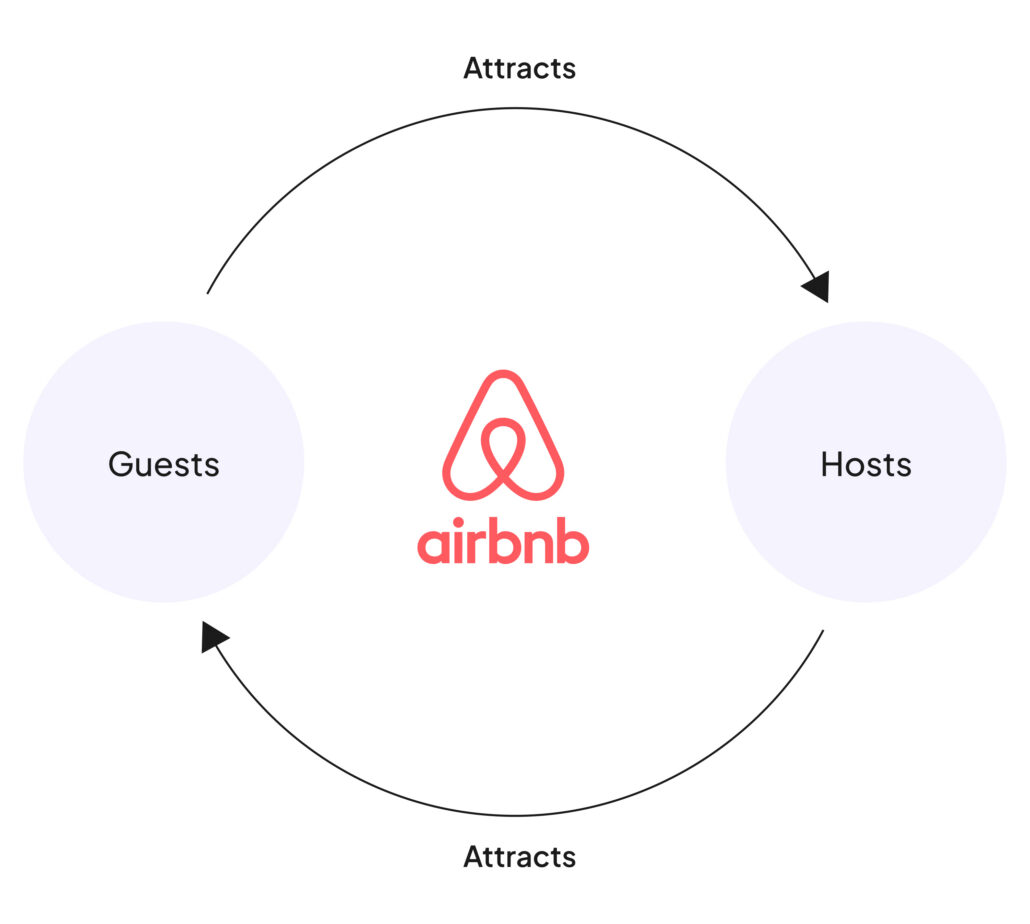
That network effect also became its defense.
Hotel companies built better websites. Travel companies launched vacation-rental products. Well-capitalized incumbents spent enormous sums fighting back. But none could easily manufacture millions of hosts and millions of travelers simultaneously. Today, Airbnb is a public company worth well over $100 billion. Its network is the asset.
There is another lesson from this example that the real estate industry should pay attention to. Airbnb was willing to color outside the lines as it raced to build those networks. Some of their tactics challenged industry conventions; others became subjects of litigation, regulation, and years of political fights. Those battles did not matter in the long run. They couldn’t meaningfully slow the networks that had already formed.
Once the network effect was established, governments, competitors and incumbents were no longer confronting promising startups. They were confronting services used by millions of people on both sides of a marketplace.
The network effect became more durable than the controversy surrounding how they built it.
Real estate contains the same raw materials: inventory, distribution, consumer relationships and data. And in 2019, Compass was already beginning to activate them.
The Compass flywheel: inventory, distribution and data
Private listings by themselves are not the strategy.
They are an input.
To understand Compass correctly, you have to see how inventory, distribution, and data reinforce one another.
1. Inventory
Compass aggregates listings from an enormous network of agents and brokerages and then creates multiple marketing phases for that inventory.
The key distinction is that some inventory enters the Compass ecosystem before it enters the broader marketplace. That puts something valuable behind the velvet rope.
Buyers feel pressure to work with a Compass agent because of the inventory; sellers become attracted to the network because of the buyers; agents feel the same pressure, bringing more listings and more buyers into the system. Then it repeats.

Compass and Robert Reffkin make impassioned arguments that multi-stage marketing benefits sellers: more control, an opportunity to test pricing, protection of days-on-market and price-history data, and a chance to build demand before broad exposure.
Whether you believe those are Compass’s primary motivations is beside the point.
The strategy creates a powerful seller story and strengthens Compass’s network. Its competitors have to answer both.
2. Distribution
Inventory only becomes strategically valuable when you can connect it to demand.
Compass has built three key layers to do that.
The first is the brokerage website. Compass.com gives the company a direct consumer destination where differentiated inventory can attract consumers, capture leads, and create relationships for Compass agents.
The second is a major portal. Through its Redfin partnership, Compass Coming Soon inventory reaches Redfin’s consumer audience. Compass currently advertises its Phase 2 Coming Soon strategy as exposure on Compass.com and Redfin.com to a combined audience of roughly 60 million buyers.
The third is agent-client collaboration through its in-house homebuyer collaboration platform, Collections.
This may be the most strategically important layer of all, because this is where the rubber hits the road. The objective isn’t merely to accumulate impressions on listings. It’s to connect differentiated inventory with high-intent buyers who are already working with agents and actively trying to consummate a transaction.
Inside Collections, agents and buyers search, save, comment, and make decisions together. That turns listing exposure into something far more valuable: observable intent.
So the architecture is:
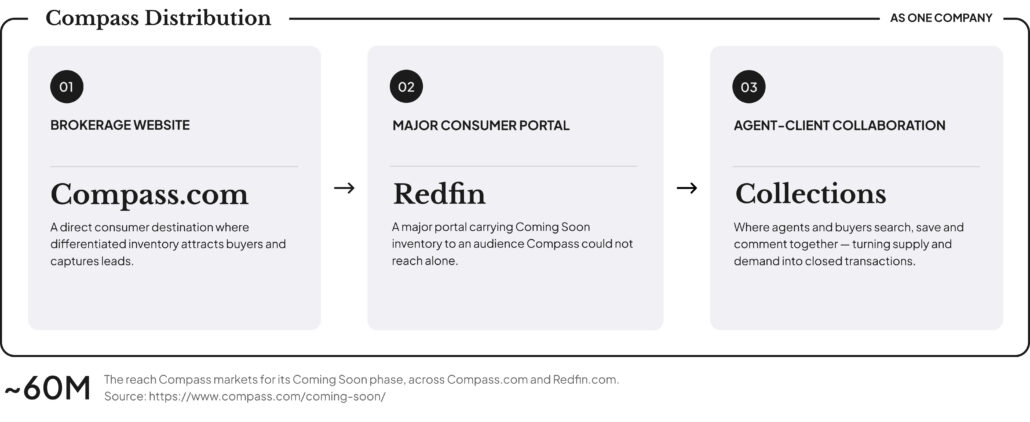
Brokerage website → major consumer portal → agent-client collaboration.
The website generates direct traffic and leads. The portal dramatically expands reach. The collaboration layer connects inventory with active buyers and captures what those buyers actually do.
Keep that architecture in mind, because we’ll return to it shortly.
3. Data
Every step in that system generates information.
Buyers view homes, save them, reject them, revisit them, share them, comment on them, and ask their agents questions. Multiply that behavior across enough buyers and listings, and you begin to develop a live picture of homebuyer demand.
Market share creates a critical mass of buyer-demand and listing data that can help a brokerage understand real-time demand, assess a home’s marketability, inform pricing, match buyers and sellers, and ultimately become a marketing and recruiting asset.
The prisoner’s dilemma has arrived
There is a dynamic in game theory called the prisoner’s dilemma. The basic idea is simple: two players might both prefer a world in which neither takes a particular action. But once one player acts, the other can no longer afford not to.
That is increasingly what is happening with pre-market inventory.
Imagine two large brokerages competing in the same market. If neither aggressively promotes exclusive or Coming Soon inventory, they compete in roughly the same shared inventory environment. Neither has a structural advantage.
Then one brokerage changes the game.
It begins accumulating inventory that buyers can access earlier through its agents and using that inventory to tell sellers a differentiated story in listing presentations. It now has something its competitor does not.
The competing brokerage may sincerely believe that simple, broad distribution is better for sellers. But if its competitor’s strategy starts winning listings, attracting buyers and recruiting agents, that belief becomes increasingly expensive to maintain.
Doing nothing no longer preserves the status quo. It means accepting a competitive disadvantage.
So the second brokerage responds with a pre-market strategy of its own. Not necessarily because that is the system it would have chosen, but because participating gives it a chance to win, while abstaining increasingly guarantees a loss.

That is the prisoner’s dilemma.
And once one significant player moves, the pressure spreads. Each participant’s rational response makes the strategy more prevalent, which increases the pressure on the next participant to respond.
Under Glenn Kelman’s leadership, Redfin was vehemently against this strategy. But following the Rocket acquisition and a change in leadership, Redfin faced the competitive reality. It ultimately entered the pre-market game, partnering with Compass to carry Compass Coming Soon inventory.
Zillow faced the same underlying competitive reality: as meaningful pre-market inventory accumulated outside the traditional, broadly distributed ecosystem, standing still would mean letting an increasingly important category of inventory develop somewhere else.
So Zillow responded with Zillow Preview.
Its answer has been to participate in the pre-market game while establishing a different architecture around it: Preview isn’t controlled by a single brokerage. Any brokerage can participate, subject to Zillow’s Listing Access Standards, and the resulting inventory can reach consumers across participating distribution channels.
In 2019, I warned that once one participant reached sufficient scale, everyone else’s choices would narrow.
That’s exactly what happened.
Redfin had to respond.
Zillow had to respond.
Realtor.com had to respond.
And if you run a brokerage or large team, you no longer have the luxury of sitting this out either.
The strongest counter to a closed network is a larger open one
For a while, the knee-jerk response available to many brokerages was to build their own private or pre-market ecosystems. At the time, it may have been their best option.
The problem is that dozens of smaller walled gardens cannot individually reproduce the liquidity of one enormous network. They also risk creating a terrible consumer experience: buyers checking one brokerage site for one pool of homes, another app for another, Redfin for another, and Zillow for another.
A few companies may have extraordinarily dense local or regional market share and can create sufficient network effects largely on their own. Howard Hanna is one example, and RealScout powers part of its Find It First solution, connecting proprietary inventory with buyer demand.
Most brokerages—even large, successful ones—don’t have that luxury.
Their path to comparable scale is cooperation. And it may actually produce a stronger network.
We’ve seen this pattern elsewhere.
The internet became vastly more powerful than any proprietary online service because anyone could build on common protocols. Email is ubiquitous because a Gmail user can communicate with an Outlook user rather than every provider maintaining its own private messaging island.
Open networks can become extraordinarily difficult to compete with because every participant contributes something while benefiting from the scale of everyone else.
Residential real estate now has the ingredients for something similar.
Brokerages syndicate pre-market inventory. A massive consumer platform supplies distribution. Agent-client technology connects that inventory with active buyers. And the behavioral data created by those interactions makes the system more intelligent.
No single brokerage needs to own the entire network.
That’s the opportunity.
The emerging open architecture
Earlier, I described the three distribution layers Compass has assembled inside a single company: its brokerage website, a major consumer portal, and agent-client collaboration. The open ecosystem can recreate that same architecture across companies.
Layer 1: Brokerage Website
If your brokerage offers pre-market inventory, your own website should showcase it. The website should demonstrate your differentiated inventory and marketing capabilities while generating traffic and leads directly for your organization.
But a brokerage website alone can’t generate enough distribution.
You need the second layer.
Layer 2: Major Consumer Portal
For some real estate leaders, this is going to be a tough pill to swallow.
Zillow has spent years being cast by some as an adversary. Many brokerage executives have built parts of their strategy around reducing their dependence on it.
But sometimes the enemy of your enemy really is your friend.
Compass is amassing a network that threatens both the traditional brokerage ecosystem and the open consumer marketplace on which Zillow’s business depends. That creates a strategic alignment that didn’t exist in quite the same way before.
And if you’re trying to counter Compass’s distribution advantage, Zillow brings a weapon that is extraordinarily difficult to reproduce: consumer attention at massive scale.
Zillow reports approximately 235 million average monthly unique users. Compass, even after extending Coming Soon inventory through Redfin, currently markets the combined Compass.com and Redfin.com audience at roughly 60 million buyers. The scale difference is nevertheless enormous.
This is one reason I’m willing to bet on Zillow Preview.
To be sure, I’m not suggesting Preview has already caught up with Compass’s pre-market inventory. It hasn’t. But I’m betting on the trajectory.
I understand the muscle Zillow is putting behind this initiative, and I’m watching how quickly brokerages are adopting it. Zillow has already signed major brokerage organizations, and neither Zillow nor its partners are treating Preview like a nice-to-have side project.
I expect the amount of inventory flowing through this network to grow substantially over the next 12 to 24 months.
And unlike a network controlled by a single brokerage, Zillow Preview is available to all brokerages. That creates the possibility of aggregating supply across companies that would never merge, share a brand or operate under common ownership.
The competitive landscape has changed. Your strategy should too.
Layer 3: Agent-Client Collaboration
This is the piece that, until very recently, was missing.
Zillow recently announced that Realtor.com and RealScout will be syndication partners for Zillow Preview listings.
RealScout does something different than portal distribution: it brings Preview inventory into the agent-client relationship.
For the first time, the architecture I have been describing becomes possible across companies:
- The brokerage has a seller-facing pre-market strategy and its own branded destination.
- Zillow supplies enormous (the largest, by far) consumer reach.
- RealScout puts the inventory back into the environment where agents and high-intent buyers are already searching together and trying to transact. And it isn’t just the brokerage’s own Coming Soon inventory. Agents and clients can collaborate around their Coming Soon listings alongside Zillow Preview listings syndicated by the many other participating brokerages, plus traditional MLS inventory.
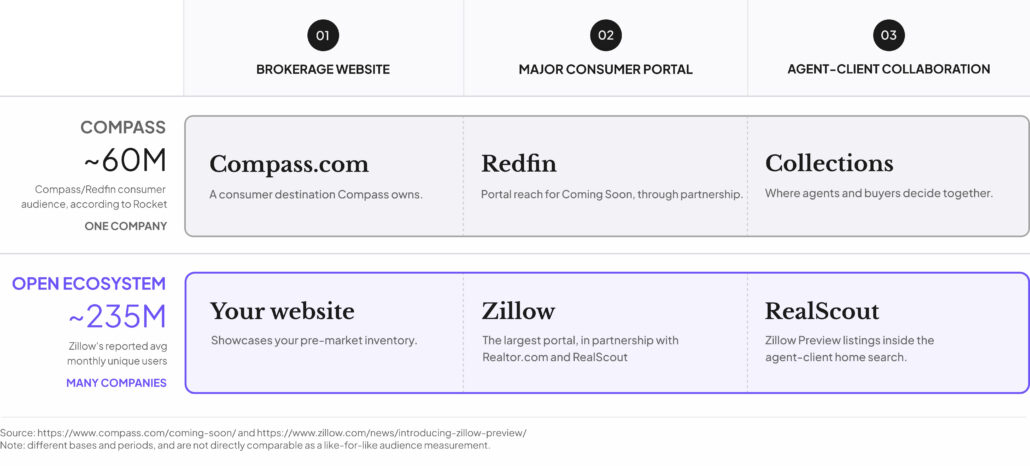
That’s a much better competitive answer. And it closes the data loop.
Which homes are buyers saving? Which are they rejecting? Where is engagement accelerating? Which buyers appear increasingly ready to transact? Where is demand accumulating before comparable inventory reaches the traditional market?
These are exactly the kinds of capabilities I described in 2019 when I argued that aggregated buyer activity and listing data could become a competitive asset.
This is how you turn Compass’s network advantage against its greatest constraint: the boundaries of its own network.
Vertical integration is Compass’s strength and its constraint
Compass has a real structural advantage: vertical integration.
When you own the brokerage, the consumer experience, and large portions of the technology stack, you can make those pieces work together. That is powerful.
But vertical integration also imposes a ceiling.
No company is going to build the world’s best CRM, the world’s best home-search and collaboration platform, the world’s best marketing system, and every other piece of technology a modern brokerage needs.
Specialists exist for a reason.
Robert Reffkin has told me directly that Compass will not integrate with RealScout. I assume the same philosophy extends to at least some other outside products that overlap with Compass’s proprietary stack.
I understand the rationale. Opening the ecosystem can weaken the strategic value of owning the ecosystem.
But that’s precisely where competitors have an opportunity.
An open architecture can combine best-in-class products across categories and make interoperability itself an advantage.
RealScout can power agent-client search, collaboration, and demand intelligence.
A sophisticated CRM such as Cloze or Follow Up Boss can manage relationships and pipeline.
Rechat can power marketing and agent productivity.
Specialized platforms can handle transactions, analytics, recruiting, AI, and whatever comes next. And APIs, MCPs, and AI-native integrations are rapidly making those systems easier to connect.
Compass gets integration through owning the entire tech stack. The rest of the industry can get integration through openness—and choose a better product at every layer.
We haven’t seen the full force of Compass yet
If anything, I think the industry is still underestimating what’s coming.
Compass is playing to win, and they will not relent.
Its combination with Anywhere brings enormous additional scale under the Compass International Holdings umbrella. The network effects described throughout this essay don’t appear instantly when companies combine. Systems need to integrate. Strategies need to propagate. Agents need to adopt them. Inventory needs to accumulate.
But when Compass successfully activates those assets, the consequences are substantial.
The Redfin partnership offers a glimpse of the strategy’s potential. Compass reported in August that it had already delivered more than 20,000 Coming Soon listings to Redfin and received more than 60,000 leads from Rocket-Redfin since launching the relationship.
That’s what playing to win looks like.
Compass understands that network effects reward urgency. Much of the industry still seems to believe it can afford to wait.
Part of that complacency comes from the hope that regulation, litigation, or MLS policy will eventually neutralize the threat.
That is a dangerous bet.
Companies like Airbnb taught us to be extremely careful about relying on legislation or litigation as a competitive defense. Companies racing toward network effects can treat those fights as speed bumps, not stop signs. Some practices get challenged. Some rules change. Some lawsuits are won, and others lost.
Meanwhile, the network keeps growing.
Once millions of participants depend on that network, removing it becomes far more difficult.
Compass understands the power of getting there first.
The rest of the industry should too.
Waiting for somebody else to stop your competitor is not a strategy.
A blueprint for competing now
If I were running a major brokerage, franchisor, or megateam today, I would organize my strategy around six priorities:
- Build a credible multi-phase listing strategy. Your agents need an answer when a Compass agent walks into a listing appointment with a three-phase marketing story. Give sellers real choices about how a home enters the market, but make sure those choices align with MLS and portal guidelines and, most importantly, are grounded in what will produce the best outcome for the seller.
- Create the three layers of distribution. Your own website should showcase pre-market inventory and generate leads; a massive consumer network should extend its reach; and an agent-client collaboration layer should connect that inventory with serious buyers. Today, I believe Zillow Preview and RealScout are the only solutions available at scale.
- Treat demand data as strategic infrastructure. Buyer activity can tell you where demand exists, improve matching, inform seller conversations, and create a more compelling recruiting proposition. Treat it as an asset.
- Participate in scale rather than waiting for it. The value of an open network increases as brokerages contribute inventory and consumers engage with it. Waiting until everyone else has proven the model means allowing someone else’s network to compound in the meantime.
- Build a best-in-class technology stack. It’s time to sunset the all-in-one platform. Integrate the industry’s strongest CRM, marketing, transaction, and productivity products into a cohesive ecosystem. You compete against vertical integration by choosing the best product at every layer.
- Execute with urgency. Network effects reward participation while the network is forming. Six or twelve months spent watching the market is not neutral time; it’s time in which your competitor’s network becomes harder to counter.
You can modify the stack, debate individual vendors, and tailor the implementation to your market, but I would not compromise on the architecture: your own distribution, broad public reach, agent-client collaboration, demand intelligence, and best-of-breed technology.
That is the counterstrategy.
Gradually, then suddenly
For years, I have returned to Hemingway’s line about change happening “gradually, then suddenly.”
What strikes me most looking back at that 2019 presentation isn’t simply that I was talking about Compass. It’s how many of the mechanics that define today’s competitive environment were already visible: concentrated market share, differentiated inventory, buyer FOMO, proprietary demand data and the possibility that brokerages unable to achieve sufficient liquidity alone would eventually have to cooperate to get there.
Nearly seven years have passed.
That is a remarkably long “gradually.”
We’re now much closer to the “suddenly.”
Compass has grown dramatically, and we haven’t yet experienced the full competitive force of its combination with Anywhere. Pre-market inventory has become a national issue. Redfin has been pulled into the game. Zillow is putting substantial resources behind Preview. Major brokerage organizations are joining it. And the technology required to create an alternative network no longer needs to live inside a single company.
The mistake now would be to interpret this as a feature war, a portal war, or even a private-listing war. Rather, it is a network-effects war.
Compass’s strategy is to use its scale to make its network increasingly valuable to everyone inside it. The counterstrategy is an even larger open network: brokerages syndicating pre-market inventory, consumer platforms creating enormous reach, agent-client technology connecting that inventory with real demand, and specialized technology companies delivering capabilities that can outperform a closed stack, category by category.
That architecture isn’t just good for brokerages. It’s one with more transparency, more competition between brokerages and technology providers, and more ability for buyers to choose the agent they believe is best for them without worrying that the home they want is hiding behind somebody else’s velvet rope.
In 2019, the industry had time to prepare.
For the most part, it waited to see what would happen.
Now we know.
Waiting is no longer a strategy.
If you’re leading a brokerage or large team and wrestling with how to compete in this environment, reach out to me personally. I’ve been thinking about this problem for nearly a decade, and I’d welcome the conversation.